Not Listed
The installation transforms the classificatory logic of everyday digital interfaces into a navigable spatial system, examining how rules, categories, and predefined choices shape what can be recognized, recorded, and acted upon.
TEXTTEXT
Curatorial text
“How does one remain human in the gloom of this world, when the bonds that unite us have been torn apart and malignant forms of rationality are operating at full force?”1
— Jonathan Crary
Taking shape along the boundaries between digital media, sculpture and installation, Merve Mepa’s practice brings historical and contemporary technologies together with local and algorithmic forms of knowledge. She approaches technology not as a self-evident, passive tool, but as a material mechanism shaped by regimes of power and carrying multiple layers of meaning, and short-circuits these mechanisms through various interventions. Mepa’s practice also aims to reveal the layered clusters of relations produced by those in power, by weaving elements inherent to everyday life into her thinking process and by restructuring data drawn from open sources and archives.
Within the framework of the Triangle II project, Mepa designs an office-like structure inside the gallery space. The office, which shapes those it admits through set rules and directives, is imagined as a space in which one develops strategies for survival. Today, the spaces in which capitalist exploitation is produced are not shaped by economic relations alone. These systems advance in coordination with post-human elements. Known in the literature as exo-capitalism, this system operates like an algorithmic nucleus.2 Such exo-capitalist formations are hybrid organisms that do not belong to a single body, living being or material environment, but come into being within a network of relations between humans, technology, data and algorithms. Within the capitalist system, then, it is no longer only human labour but also the individual’s behaviours, cognitive processes and social relations that are instrumentalised and turned into resources.
The installation Not Listed draws attention to the fragility and vulnerability of the human being as mediated by technology. According to Jonathan Crary, today’s late-capitalist reality imposes a new model of normativity, one that constructs its reality within a universe of 24/7 temporality: “24/7 steadily undermines distinctions between day and night, between light and dark, and between action and repose. It is a zone of insensibility, of amnesia, of what defeats the possibility of experience.”3
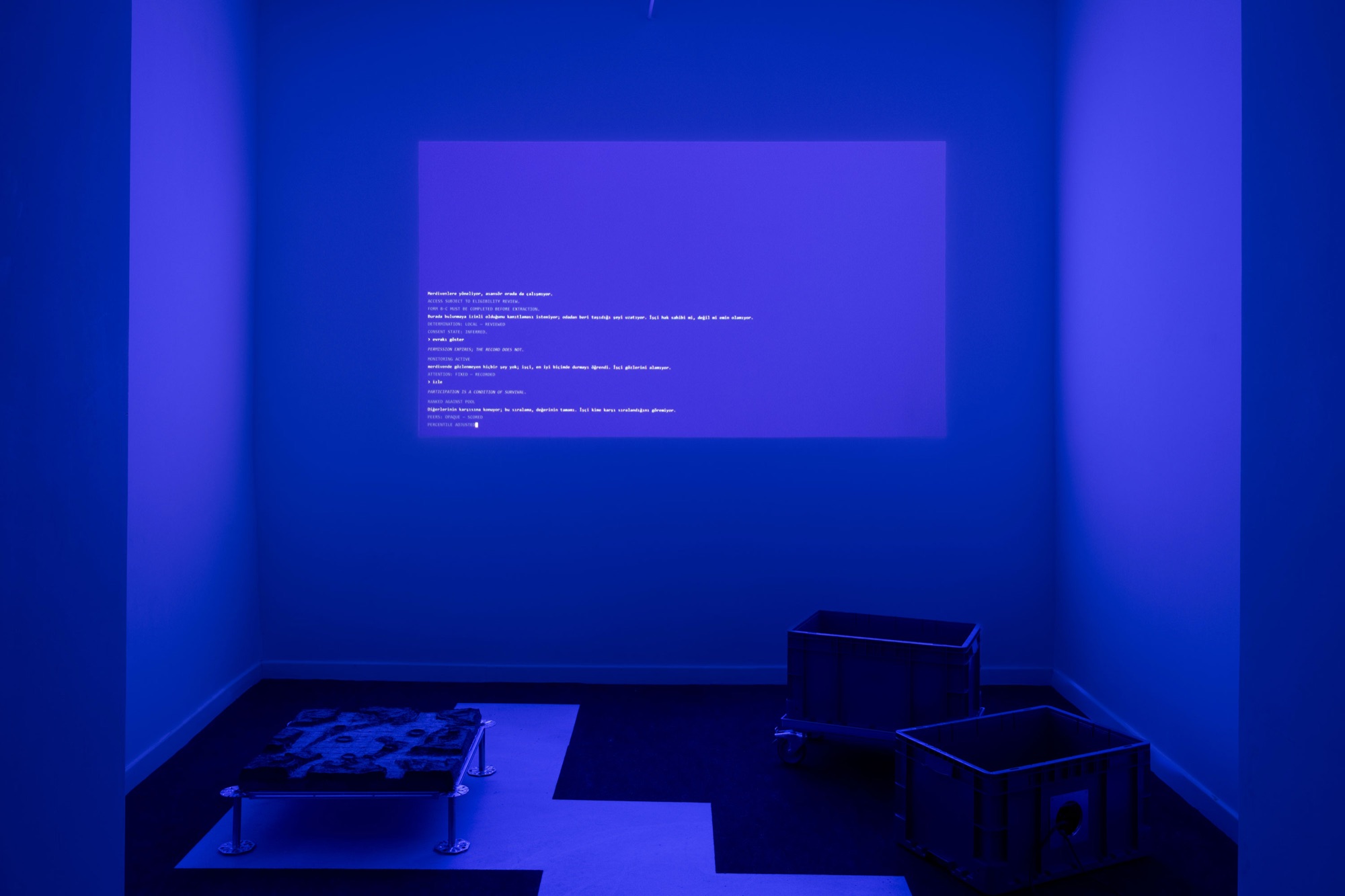
Visitors entering the space of Not Listed are first met by carpet tiles. While this inviting carpet pattern symbolically refers to office spaces, it is also a manifestation of Mepa’s relationship with gaming culture.
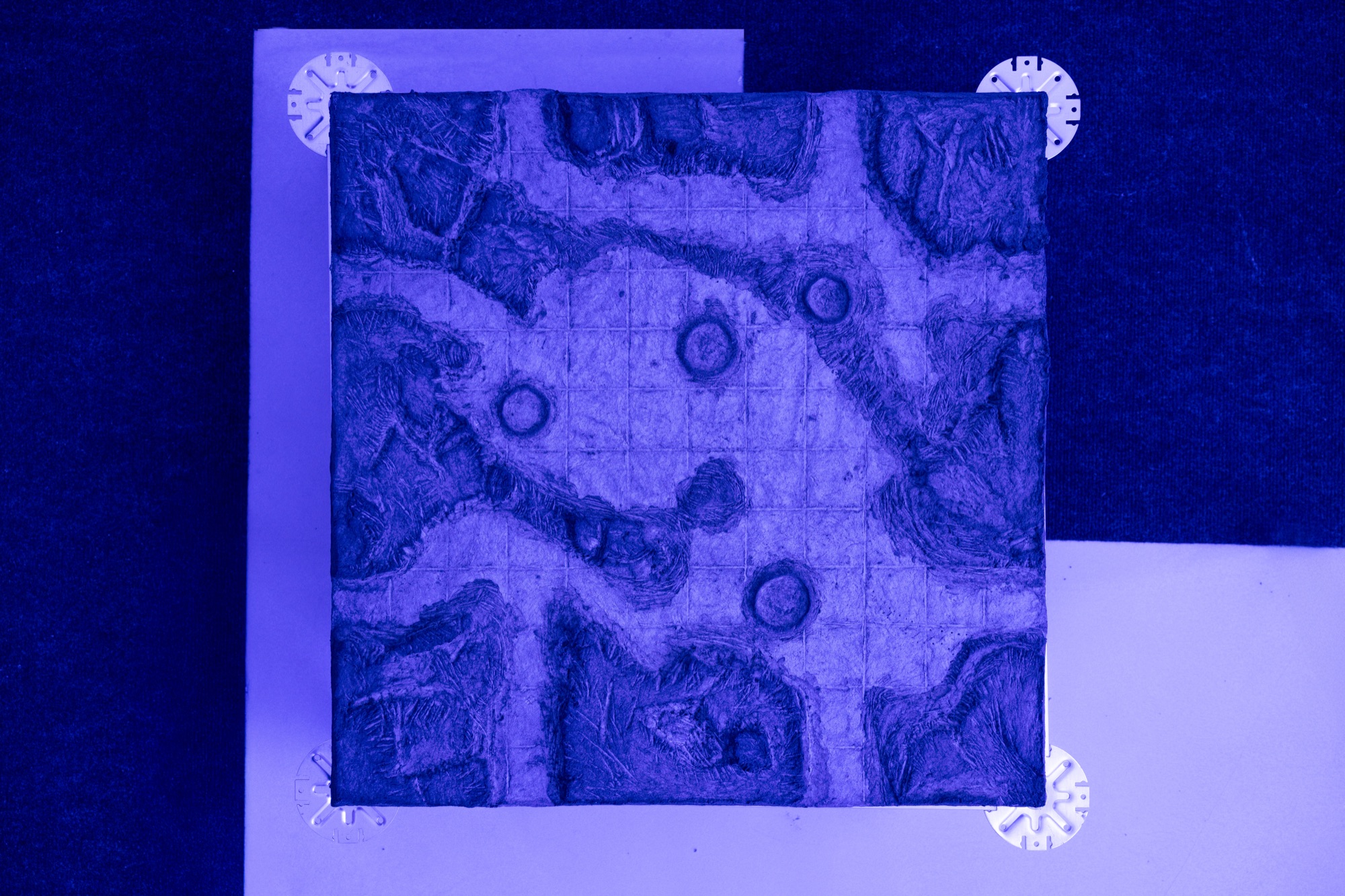
In Mepa’s works, sets of concepts drawn from gaming culture form, sometimes implicitly and sometimes directly, the core or partial backbone of the work. Elements related to games can play a fundamental role in the construction of space as well as contribute to the formation of the narrative. In building the spatial setup for this exhibition, Mepa draws on the concept of Dungeon Morphism. Unlike procedural dungeon generation techniques, Dungeon Morphisms do not produce predetermined, consistent maps; instead, they rebuild dungeons through structural transformations. New connections and spatial networks are formed by adding, removing and rearranging the elements of the dungeon. Containing elements such as dead ends and secret rooms, these maps allow the player to encounter a different field of experience with each use. Designed for the Triangle II project, Not Listed likewise adopts Dungeon Morphism as a kind of exhibition methodology.
The carpet tiles create a pixelated pattern in the space, reminiscent of 1990s game aesthetics. The viewer is left to wander freely, as if inside an open-world game. A common assumption about games with open-world maps is that players can move freely within the created world and do as they please. While this is partly true, such freedom is relative. Although the player appears to be in an active position, they are essentially a passive agent moving within an area whose limits have been set in advance. Not Listed allows viewers to move freely, but, as in every open-world game, it also contains certain limits and constraints.
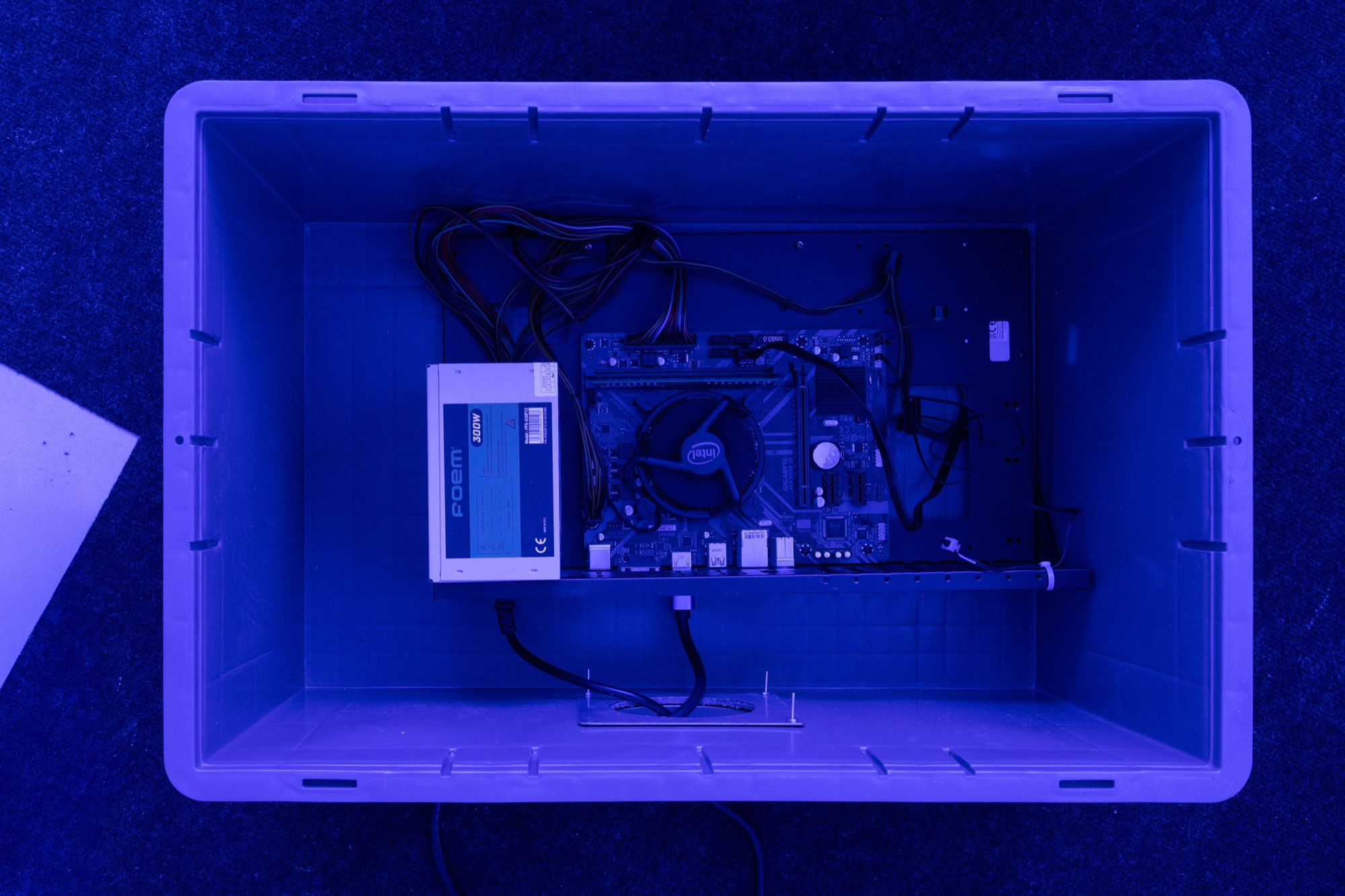
The space contains a dungeon platform, a video and a small amulet. Made as a single piece, the dungeon platform forms a topographic map while also helping to create a new space within the space. Another platform consists of two plastic archive boxes and a computer case placed inside one of them. Used in offices to store and archive paper, these boxes are stripped of their original function here and become part of the spatial setup. They can also be read as a “threshold object” representing the transition from physical storage practices to digital data storage.
From the computer case placed in the office boxes, a text-based, speculative story is projected onto the wall. The story invites the viewer on a pre-designed walk. In this textual flow, which begins with a dialogue between two characters and a series of directives, we witness the futile efforts of a worker trapped in a dungeon to escape. The dark atmosphere of the video and its long, meaningless pauses evoke the gloom of uncanny, cold bureaucratic spaces. Carrying a philosophy of walking, the video points to the condition of the human in late capitalism as not only fragmented but turned into data itself.
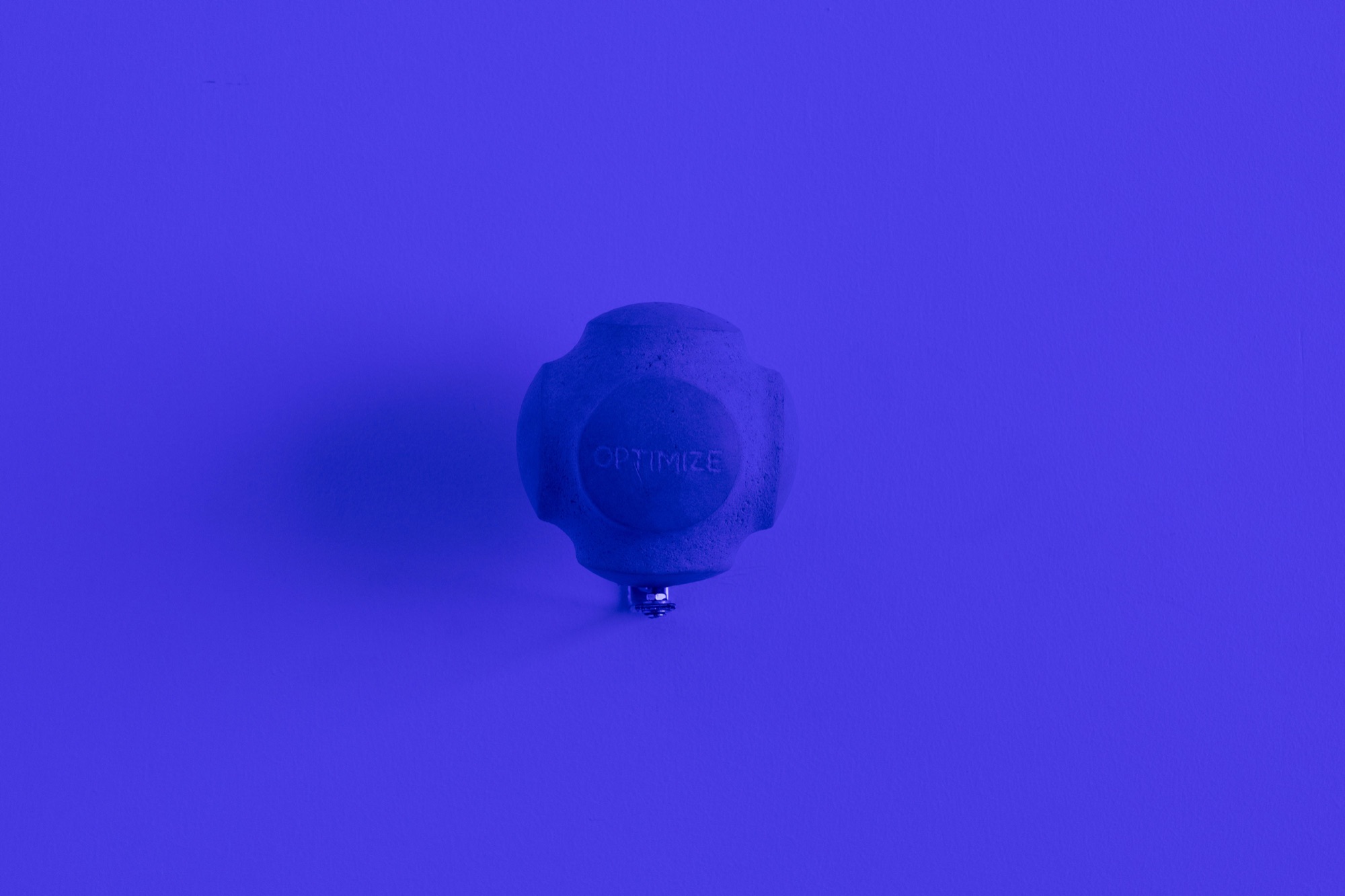
On the left side of the room is a small amulet. Frequently encountered in role-playing games, such an amulet grants the character extra energy, health or other attributes depending on the character’s class. Yet the amulet is not only a fictional object. With a history going back thousands of years, it is an object believed to bring luck or to protect against evil forces, made from precious stones or metals, or from materials such as clay and ceramics. Mepa’s amulet takes its own shape within the office space. Made of ceramic, with inscriptions placed at its corners, it recalls the decision die used in board games. Unlike a decision die, however, it bears not given directives but the instructions that appear in the video. Rather than offering the worker trapped in the dungeon a way out, the die locks them into the same loop.
In a sense, an analogy is drawn between the gamer and the office worker, as both seem to share a similar fate when it comes to determining their own destiny. Both act within an illusion of freedom, only to the extent the system allows, and count survival as success.
As a dungeon in its entirety, the office space evolves into a place where hybrid bodies emerge as phenomena. The place where today’s human is positioned oscillates on a threshold between fever and madness. While Merve Mepa’s Not Listed makes visible the elements of the human trapped in the office space, it deconstructs reality through the components of the game. The emancipatory aspect of play,4 in turn, brings human elements back into focus through the mediation of the non-human.
- Jonathan Crary, 7/24: Geç Kapitalizm ve Uykuların Sonu (İstanbul: Metis Yayınları, 2015), 93–94. ↩
- Marek Poliks and Roberto Alonso Trillo, Exocapitalism (Becoming Press, 2025), 116. ↩
- Jonathan Crary, 7/24: Geç Kapitalizm ve Uykuların Sonu (İstanbul: Metis Yayınları, 2015), 27. ↩
- Uras Kızıl, “Oyunun Özgürleştirici İfadesinin Yitimi Üzerine,” e-skop, 20 June 2017, e-skop.com. ↩
- Year
- 2026
- Medium
- Carpet tiles, papier-mâché on raised floor panel, Polaroid photograph, ceramic object, plastic archive boxes, open-frame computer, test bench, modular display
Dimensions variable - Shown at
- Triangle II, Rast Gallery
- Curator
- Uras Kızıl